











Football fans in the Democratic Republic of Congo often look for ways to understand upcoming matches before placing wagers. Reviewing team performance, recent results and statistical trends can support more informed decisions. This page explains how match analysis works, which factors matter most and why no forecast can guarantee an outcome.

Ready-made advice can be useful as a starting point, but the most valuable skill is learning to evaluate a game yourself. Understanding probability, team form and market prices turns a decision from guesswork into a repeatable process. It also makes it easier to recognise when the available information is too limited and passing on a wager is the sensible choice.
What is Fortebet Prediction
A football prediction is an assessment of how a match might unfold based on available information. Analysts examine recent performance, head-to-head records, league standings and injury reports to estimate which outcomes are more or less likely. Fortebet covers major African leagues, European tournaments and international fixtures, giving Congolese fans a broad selection of events to review.
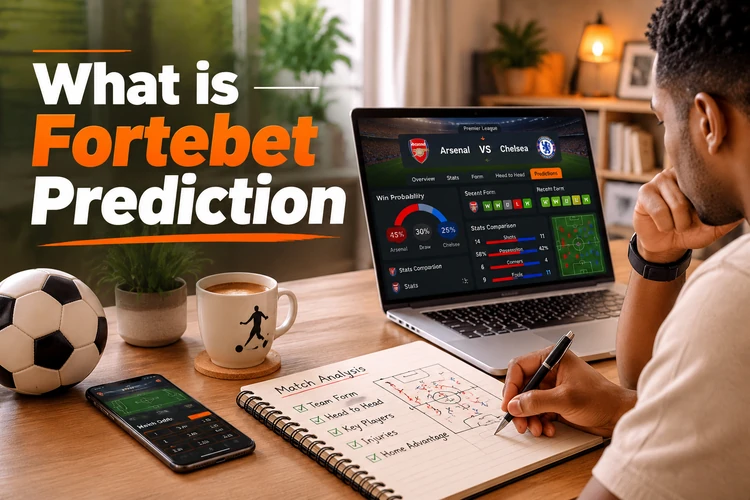
Forecasts should be based on measurable factors rather than a hunch. Form across the last five to ten matches can indicate current momentum, although the quality of the opponents must also be considered. Home advantage, away performance, suspensions, injuries and tactical changes may all shift the balance. No single statistic determines the result; the aim is to combine relevant evidence.
Odds represent the market's assessment of probability, but they are not a prediction of what must happen. Comparing a price with your own estimate can help identify possible value. For example, a team that you assess at a 50% chance has fair decimal odds of 2.00 before considering margin. If the available price is materially higher, the difference deserves examination, not automatic action.
Mathematical Models in Football Analysis
Statistical models bring structure to match evaluation. One widely used measure is expected goals, or xG, which estimates the quality of chances created from factors such as shot location and situation. A team that regularly produces better chances may score more over time, even after an unlucky run of results. Comparing xG with actual goals can reveal whether recent results are supported by performance.

Probability models assign an estimated likelihood to possible results. A simple example might rate a home win at 50%, a draw at 25% and an away win at 25%. These figures are estimates, not promises, and model quality depends on the data and assumptions behind them. Useful inputs can include shot volume, defensive actions, possession, set-piece efficiency, ratings and past results.
League position provides useful context, but it can hide recent changes. A managerial appointment, a difficult run of opponents or several matches in a short period may affect the next fixture. Models also need careful interpretation in leagues with limited public data. Where information is incomplete, confidence should be lower rather than replaced with certainty.
Daily Match Analysis
Football schedules run throughout the year, with fixtures across different time zones and competitions. Reviewing matches on a particular day means checking current team news, confirming likely lineups and noting late changes. A missing striker, goalkeeper or central defender can matter more than a small difference in recent league position.
Begin with competitions and teams you understand. Check each side's recent results, the strength of its opponents and its home or away record. Then review scoring patterns: some teams create open, high-scoring matches, while others rely on a compact defence and produce fewer chances. Fixture congestion may lead to rotation, especially when a league match follows a demanding cup or international game.
Weather and pitch conditions can add context. Heavy rain may reduce passing accuracy, while extreme heat can affect intensity late in the match. These details should support the main analysis, not replace it. A practical preview should explain what is known, what is uncertain and which new information could change the assessment before kickoff.
Practical Betting Advice
Bankroll management protects funds and limits the effect of variance. Set a separate betting budget and choose a consistent stake before reviewing individual matches. A small fixed percentage, such as 1% to 5% of that budget, is easier to control than changing the amount after every result. The right figure depends on personal finances and tolerance for loss.
Never chase losses by increasing stakes after a bad result. A losing streak can occur even when an assessment has a genuine statistical basis. Keep a simple record of the date, market, odds, stake, reasoning and outcome. Reviewing this record later can show whether decisions were based on evidence or influenced by emotion.
Different markets suit different match situations. Match-result betting focuses on the winner or draw, while goal totals depend on the expected scoring level. Both-teams-to-score markets require a goal from each side, and handicap lines adjust the starting margin. Correct-score markets are much less forgiving because they require a precise final result. Read the settlement rules before placing any wager.
Selective betting is usually more practical than trying to cover every fixture. If team news is unclear or the price does not reflect the risk, skipping the match is a valid decision. Players using a phone can review the Android application, while existing members may sign in to their accounts to check current markets.
Football Competitions and Betting Markets
Football analysis can cover domestic leagues in Congo and neighbouring countries, continental competitions such as the CAF Champions League, European divisions and international qualifiers. The amount and quality of available data varies. Major European competitions often provide detailed event statistics, whereas some local fixtures may require greater attention to match reports, local news and confirmed team information.
International matches deserve additional care because players join from different clubs, preparation time is limited and motivation can vary. Friendly fixtures may involve substitutions that make historical results less useful. In knockout games, a team may prioritise avoiding defeat, while a league match later in the season may be shaped by relegation or qualification pressure.
Before choosing a market, ask what the evidence actually supports. Strong attacking numbers may support a goal-based market rather than a match-winner selection. A defensive team with a reliable home record may suit a conservative line, but head-to-head history should not be treated as decisive when squads and coaches have changed. The market must match the underlying argument.
Responsible Gambling Principles
No prediction method removes risk. Football contains uncertainty, and an underdog can win even when the stronger side has most of the statistical advantages. A 70% estimated probability still implies that the outcome fails roughly three times in ten comparable situations.

Only wager money that you can afford to lose. Essential expenses such as rent, food, transport and family obligations should come first. Set a weekly or monthly limit in advance and stop when it is reached. Do not borrow money to bet, and do not treat gambling as a way to repay debts or create income.
Take regular breaks and pay attention to changes in mood or behaviour. Betting to recover losses, hiding activity from others, neglecting responsibilities or feeling unable to stop are warning signs. If gambling becomes stressful or financially harmful, use available support and consider deposit limits or self-exclusion tools where offered. Speaking with someone you trust can also provide useful perspective.
Gambling is for adults only. The age marker is 18+, and minors must not use betting services. Keeping account access private and using responsible-gambling controls helps protect both the player and the household.
Frequently Asked Questions
It is an assessment of a football match based on factors such as team form, statistics, injuries and likely tactics. It helps frame probabilities but cannot guarantee a result.
An analysis may combine recent results, opponent strength, home and away performance, league position, team news and tactical information. Statistical measures such as expected goals can add context, but incomplete data lowers confidence.
Mathematical prediction applies statistical models to estimate the likelihood of different outcomes. Comparing an estimate with available odds may help assess value, but the model remains an uncertain calculation rather than a promise.
No. Unexpected goals, injuries, refereeing decisions and tactical changes can affect any match. A probability estimate describes likelihood, not certainty, so every wager carries the possibility of loss.
Analysis should be reviewed when meaningful information changes, particularly after injury news, lineup confirmation, postponement or a major market movement. Checking close to kickoff can provide more current context, although it still cannot remove uncertainty.
Review recent form, opponent quality, home and away records, expected goals, chances created and conceded, league position, injuries and fixture congestion. Use head-to-head records carefully because older meetings may involve different players and coaches.
Treat a tip as a starting point for independent research. Check the reasoning, current team news, market rules and odds, then decide whether the risk suits your budget. There is no need to follow a tip when the evidence is unclear.
A defined budget and consistent stake limit the impact of losing runs. They also reduce emotional decisions such as chasing losses or raising stakes after a win. The budget should always come from spare funds, never essential money.